|
|
Research, Projects, Events, Publications
|
|
|
|---|
Dear Visitor,
Here comes the latest Transport Newsletter of the International Maglev Board, this time focusing on EMS (attractive) Maglev research in Russia, China and Germany, on project marketing films and some progress in Transrapid technology.
|
|
|---|
|
|
|
Transrapid MAGLEV RESEARCH PROGRAM
IN CHINA UNTIL 2035
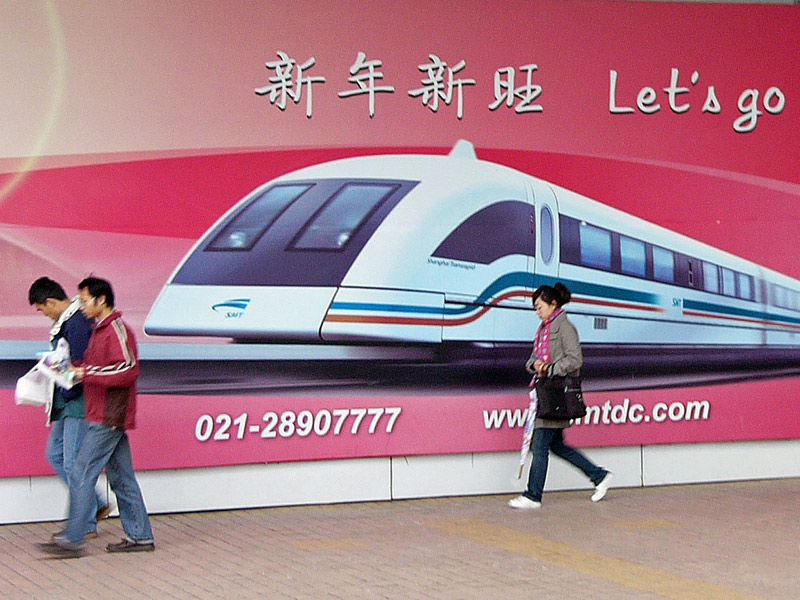
CHINA has published its ambitious National Transportation Plan 2021-2035, according to which the rail network is to expand to 70,000 km [43,500 mi] of high-speed lines and 130,000 km [80,800] of conventional lines by 2035. It focuses on the development of intercity networks in the Jingjinji, Yangtze River Delta, Greater Bay and Chongqing-Chengdu areas. The plan also calls for further development of a maglev system based on Transrapid's EMS technology to connect selected major cities. Two projects are currently underway in China for the further development of EMS maglev trains, which are expected to reach speeds of up to 600 kilometers per hour [370+ mph]. Cooperation agreements exist between ThyssenKrupp Transrapid GmbH and the University of Stuttgart, among others.
In Chinese urban and regional transport, several urban maglev systems are already in everyday operation or in the test phase, among others in cooperation with the Max Bögl company and its Transport System Bögl (TSB). Further rail systems are under development.
An English-language report by Andrew Benton can be found in the trade publication International Railway Journal, among others.
|
|
|
|
|
|---|
|
Grafik: RusMaglev 2020
|
|
MAGLEV PLANNING STUDY
MOSCOW - ST. PETERSBURG
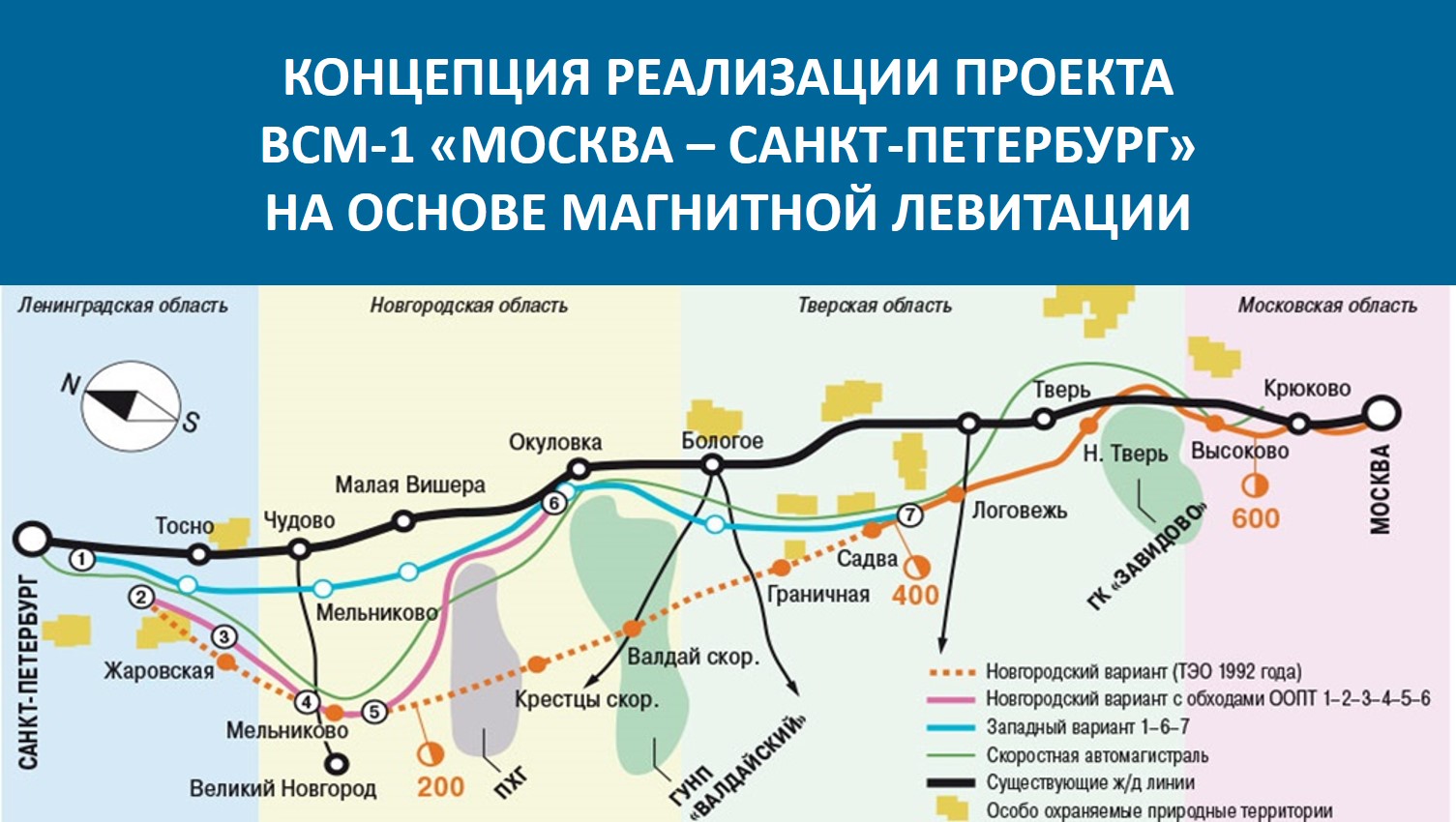
In Russian transport route planning up to 2035, the use of maglev technology should also to be investigated for the Moscow-St. Petersburg high-speed line. In this context, the maglev system is to be compared with a wheel/rail high-speed system. Based on the results, the State Council of the Russian Federation is then to make a decision on how to proceed. These demands, which are presented in an article in the Russian transport journal RZD-Partner, are clearly influenced by the successful Chinese and Japanese maglev developments in high-speed transport.
Russian experts expect that the infrastructure costs of a maglev (design speed 550-650 km/h [342-404 mph]) and an R/S high-speed system (max. 350 km/h [217 mph]) will converge on this comparison, since in each case the track would have to be built largely elevated.
In principle, the two transport technologies should be compared on the basis of a number of criteria, such as performance, reliability and safety of transport; environmental impact; energy requirements per square meter of usable vehicle area; life cycle costs, etc.
|
|
|
|
|
|---|
|
|
|
ACTIVITIES FOR THE REACTIVATION OF THE
TRANSRAPID TEST FACILITY EMSLAND, Germany
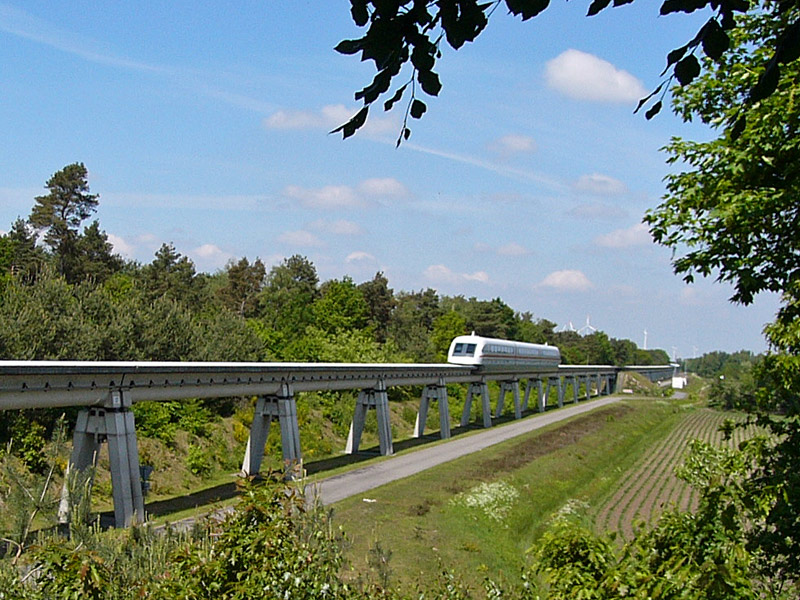
The company IABG, which manages the Transrapid Test Facility Emsland (TVE) in Germany, has confirmed initial talks with the Chinese railroad group CRRC aimed at resuming test operations at the track for new Chinese developments of the Transrapid. Tests in the range of up to 600 km/h [370+ mph] are to be carried out.
The current condition of the TVE is considered to be in need of repair. The windings of the linear motor, as well as the slotted waveguide, have already been removed from the guideway. Restarting the trial operation would require significant investment in infrastructure. It would also require a time-consuming planning lead time and might even conflict with the legally fixed dismantling of the plant. The CRRC's motives are unclear, as Chinese locations for new maglev test tracks are also being discussed, which could themselves possibly even become part of a future application track.
|
|
|
|
|---|
|
|
|
Transrapid RESEARCH
AT THE UNIVERSITY OF STUTTGART
At the University of Stuttgart, under the direction of Prof. Dr. Peter Eberhard, a new approach for modeling electromagnets of the Transrapid maglev train is being investigated with the aim of effectively and efficiently representing statics and dynamics in a frequency range relevant for the design of magnet control and for use in mechatronic simulation models. The effects of magnetic reluctance, fringing/ leakage flux, magnetic saturation and eddy currents, among others, are considered.
The new approach can be applied to any support/guidance magnet of a vehicle and is shown ideally for Transrapid support magnets. The model is validated on the basis of the parameters of the latest Transrapid vehicle TR09.
|
|
|
|
|
|---|
|
|
|
RESEARCH ON GUIDEWAY MANUFACTURING
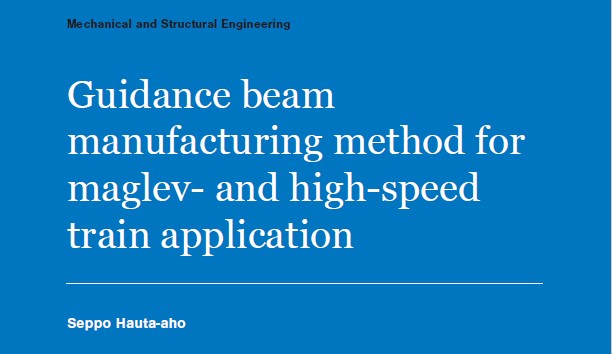
Dr. Seppo Hauta-Aho from Finland has written a dissertation on new methods in guideway construction, including for the Transrapid system, under the title: "Guidance beam manufacturing method for maglev and high-speed train application":
The English-language dissertation can be downloaded free of charge in Pdf format on the Internet.
|
|
|
|
|
|---|
|
(Screenshot 2021-03-27)
|
|
Maglev PlanNing Baltimore - Washington DC
in THE USA
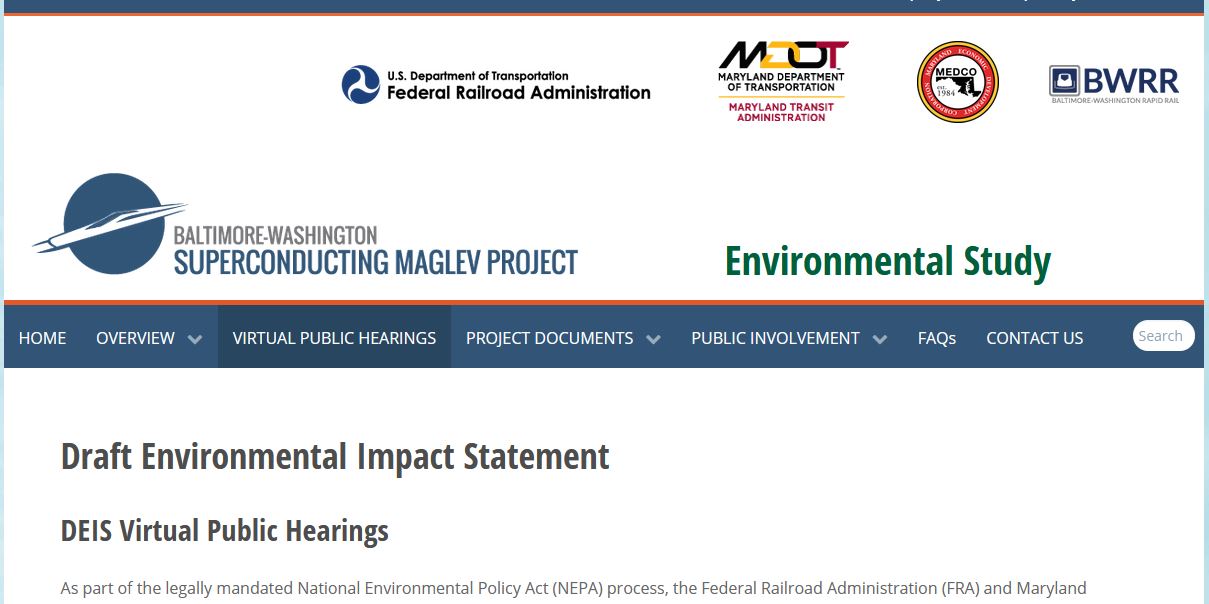
As part of the statutorily mandated National Environmental Policy Act, the Federal Railroad Administration and the Maryland Department of Transportation are conducting virtual public hearings as part of an environmental impact analysis for the Baltimore-Washington Superconducting Magnetic Levitation project.
Despite sustained opposition from residents, civic associations and elected officials in the project’s path, and after more than a year of delays, the federal government is nearing completion of its review that could lead to construction. The project could begin operating as early as 2030, according to recent news accounts.
Dates for April 2021 are listed on the project website ...
|
|
|
|
|
|---|
|
|
|
Cobra Urban MagleV, BraZIL
Under the direction of Prof. Dr. Richard Stephan, the University of Rio de Janeiro (UFRJ) developed the MagLev-Cobra system for use in urban transportation, especially for South American metropolises, starting in 2014. On a 200-meter [124-foot] track on the university campus, equipped with NdFeB permanent magnet rails, the tests are carried out with the Cobra prototype, which can transport 20 passengers. There are 24 cryostats with YBCO high-temperature superconductor (SML) blocks in the car floor.
This is the first system with this magnet technology (SML). From 2014 to March 2020, the test vehicle carried more than 20,000 passengers on regular visitor trips.
A video gives an overview of the Cobra system: photos of the system can also be found on the IMB website.
The current state of development of the Cobra Urban Maglev System is presented in a short report ...
|
|
|
|
|
|---|
|

(Screenshot YouTube)
|
|
Marketing Video About
Virgin Hyperloop
Virgin Hyperloop has released a video for marketing purposes that shows a visionary journey for Hyperloop passengers using this ultra-high-speed transportation system. The film is intended to generate interest in this system in particular, as it addresses what seems to particularly intrigue proponents about the Hyperloop plans. The film already has over 1.1 million views on YouTube.
The video shows the various stages of an imaginary Hyperloop journey, from arrival at the station portal to boarding the Hyperloop vehicle capsule. Futuristically designed stations welcome passengers as they make their way to their Hyperloop capsules. At departure time, up to six vehicle capsules are scheduled to leave the station area and converge in the main vacuum tube to race in convoy to the destination station at speeds of over 1,200 km/h [745+ mph].
|
|
|
|
|
|---|
|
|
|
VISUALIZATION OF AN URBAN MAGLEV IN BERLIN
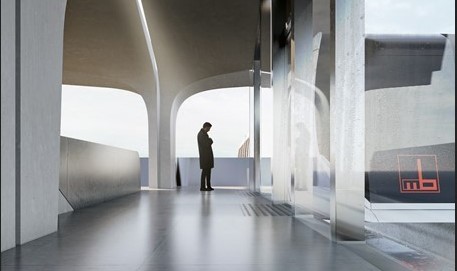
On behalf of the construction company Max Bögl, the Berlin-based architecture firm "Graft" has created a visualization of a maglev system in an urban area in the vicinity of Berlin's main train station. The visualization includes the depiction of the track, vehicles and stations of a fully automated TSB maglev system, which is intended to contribute to low-noise and low-emission traffic in urban conurbations in the future.
The visualization works with optical effects, such as strong light-dark contrasts, fairy-tale colors and dramatic evening skies. The visualization thus appears as cheerful marketing for an ambitious transport technology that is now being further developed for speeds of up to 170 km/h [105 mph] together with Chinese companies and authorities.
|
|
|
|
|
|---|
|
|
|
CONFERENCES, SYMPOSIA, WORKSHOPS,
ONLINE EVENTS
-
MTST‘21 in St. Petersburg; Russia, End of May 2021 (planned)
-
LDIA Symposium in Wuhan, PR China, July 1 - 2, 2021
-
ISMB17 Conference, Rio de Janeiro, Brazil: Aug. 18 - 21, 2021.
-
MAGLEV 2021 Conference, PR China, Changsha, Nov. 11-12, 2021
-
STECH 2021 Symposium in Tokyo, Japan, Nov. 23 - 25, 2021
-
InnoTrans 2022, Germany, Berlin, Sept. 20 - 23, 2022
MTST'21 in St. Petersburg, Russia is expected to be a hybrid event with online blocks (Zoom video conference) and face-to-face lectures (PGUPS University in cooperation with RusMaglev).
No further decisions have yet been made regarding the Maglev 2021 conference in China.
All current and available information on times, location, deadlines and contact persons of the events can always be found on the IMB website under Conferences.
|
|
|
|
|
|---|
|
|
|
NeuPERSONALITIES:
NEW IN THE IMB'S CIRCLE OF PROFESSIONALS
Prof. Dr. Antonio C. Ferreira, Brasilien
Prof. Dr. Antonio C. Ferreira is a professor at the Department of Electrical Engineering, Graduate School of Engineering, Federal University of Rio de Janeiro, Brazil. He received the degrees of E.E. (1987) and M.Sc. (1991) from the Federal University of Rio de Janeiro and the Ph.D. from the University of Cambridge, U.K. (1997), all in electrical engineering. His research interests are in power systems and electrical machines. He teaches at the undergraduate and postgraduate levels and has been involved in several research projects funded by government and industry..
Prof. Dr. Weihua Zhang, VR China
Prof. Zhang is a senior researcher of the Research Center for Super-High-Speed Evacuated Tube Maglev Transport, Southwest Jiaotong University (SWJTU) and a state-appointed expert. He has received the Special Government Allowances from the State Council and grants from the National Science Fund for Distinguished Young Scholars. He is also the chief scientist of the 973 Program and an expert of the General Group of Independent Innovation in High-Speed Trains.
Prof. Dr. Zigang Deng, VR China
Prof. Dr. Zigang Deng is a professor at the State Key Laboratory of Traction Power (TPL), SWJTU, Chengdu, China. Prof. Deng received the B.E. degree in Mechanical Engineering from Southwest Jiaotong University (SWJTU), Chengdu, China, in 2004 and the Ph.D. degree in Transportation Engineering from SWJTU in 2009. He is the leader of the innovation team for HTS maglev technologies at the State Key Laboratory of Traction Power (TPL), Southwest Jiaotong University SWJTU, Chengdu, China.
|
|
|
|
|
|---|
|
|
|
Scientific Publications
of the IMB
All documents can be downloaded as pdf documents on the scientific platform Researchgate.net via the IMB website under the links mentioned in each case. All scientific studies and reports follow the open access principle and are thus available free of charge.
|
|
|
|
|
|---|
|
|
( THE INTERNATIONAL MAGLEV ASSOCIATION )
The International Maglev Board (IMB) is an international, non-profit organization that deals with mobility, transportation and - as a focus - maglev technologies. The IMB is located in Europe, in Munich, Germany and is recognized by the Free State of Bavaria as a non-profit organization.
The International Maglev Board consists of internationally recognized transportation scientists, engineers, experts and members of NGOs. It is an independent, scientifically oriented non-profit society that is not tied to any particular maglev technology, nor to any industrial companies.
|
|
|
|
|---|
|
|